New Environment Class 01
INTRODUCTION TO THE SUBJECT (05:10 PM)
- Discussion of the syllabus.
- Carries a good weightage in the prelims stage)Approx 20 questions on average.
- Sources: Class notes and material(MCAR class)
- Prelims question(PYQ) discussed.
APPROACH (06:00 PM)
- Basic concepts should be thoroughly covered.
- Having a genuine curiosity for your surroundings actually matters in the preparation.
ECOLOGY (06:10 PM)
- The sum total of all conditions and influences that affect the development and life of all organisms on the earth in their own surroundings.
- Gaia hypothesis was proposed by James Lovelock in the year 1972 which says the earth is a self-regulating body.
- Ecosystem is a complex relationship between living and non-living components. It is a community with lifeforms in concurrence with non-living components interacting with each other.
- The scientific study of interaction in an ecosystem is called ecology.
- There are two branches in ecology-
- a)Autecology refers to the study of the relationship of individual species with an environment. It is also known as population ecology.
- b)Synecology refers to the study of a group of organisms with multiple species in its relationship with the environment. It is called community ecology.
LEVELS OF ORGANISM (07:10 PM)
- 1)Organism also called an Individual is the basic unit of the study of ecology, It is a living individual of species with the ability to function independently.
- 2)Population-Group of individuals with the same species, functioning as a unit of a biotic community.
- 3)Community- Includes population of different species that live with each other in a habitat.
- 4) Ecosystem is a part of a larger biome, where living organisms interact with each other and with their physical environment.
- 5)Biome-Large regional unit characterised by major vegetation type and associated fauna found in specific climatic zones.Examples: Desert biome, Forest biome, Tundra biome.
- 6)Biosphere is a part of the earth, where life can exist. It is the interaction zone of the lithosphere, atmosphere and hydrosphere.
-

INTERACTIONS (FLOW OF ENERGY) (07:29 PM)
- Explained through diagrams and charts.
-
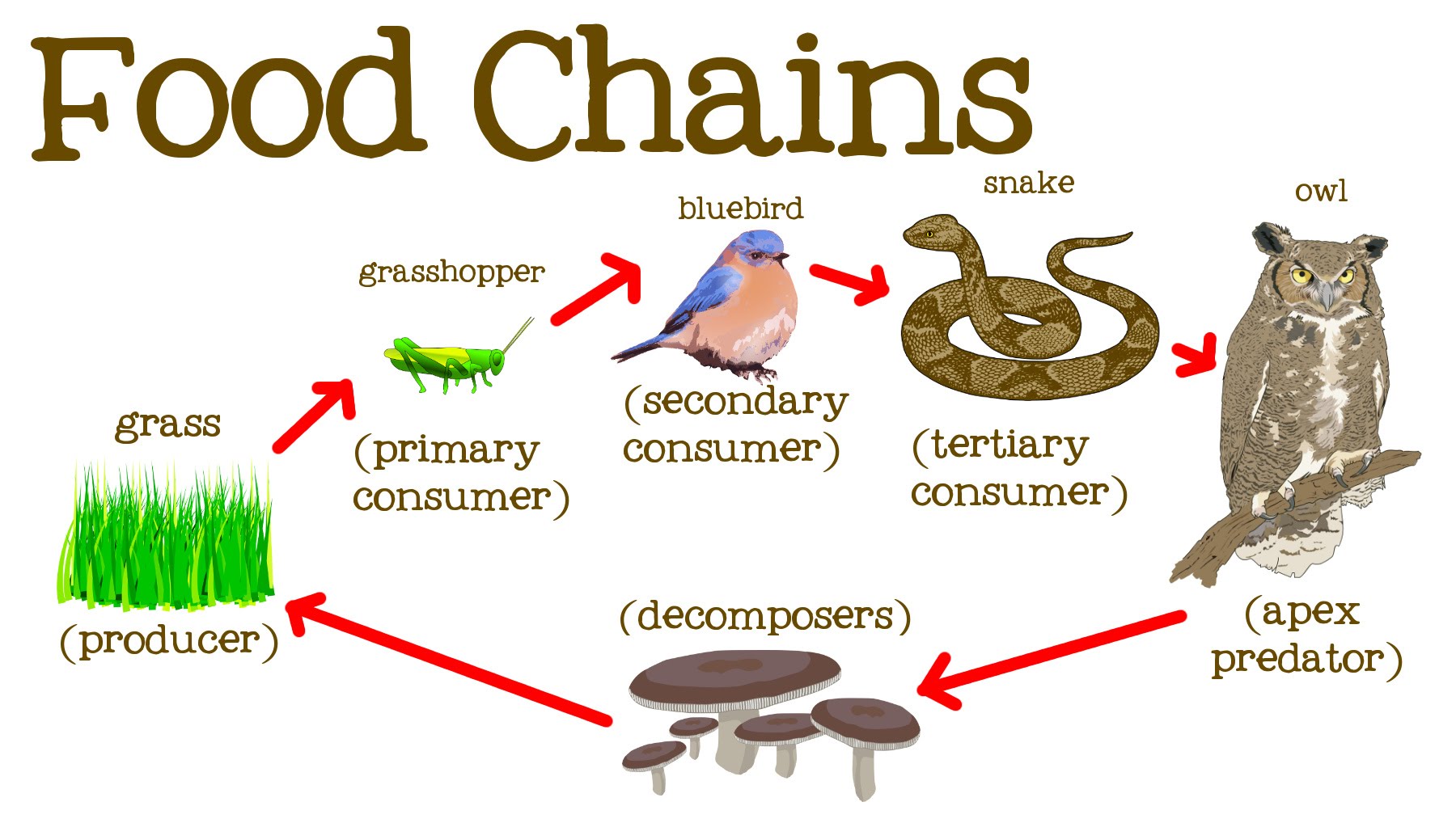
- FOOD CHAIN
- It is the chain of organisms existing in any natural community through which energy is transferred.
- Two types of food chain-
- a)Grazing-Begins with green plants(Not necessarily plants) can also begin with phytoplankton-primary producers.
- b)Detritus -Begins with dead matters.
- FOOD WEB
- The network of interconnected food chains so as to form a number of feeding relationships amongst different organisms of the biotic community.It provides stability to the ecosystem.
-

WILDLIFE (07:57 PM)
- The IUCN red list gives the overall presence of all the organisms present on the planet Earth.
- It covers both plants and animals.
- The region and habitat are important in which region in India it is found and what type of habitat it is.
- IUCN status list, Please refer to the below diagram(As we go rightward in the diagram the risk of extinction increases)
-

The topic for the next class: the IUCN list continued.